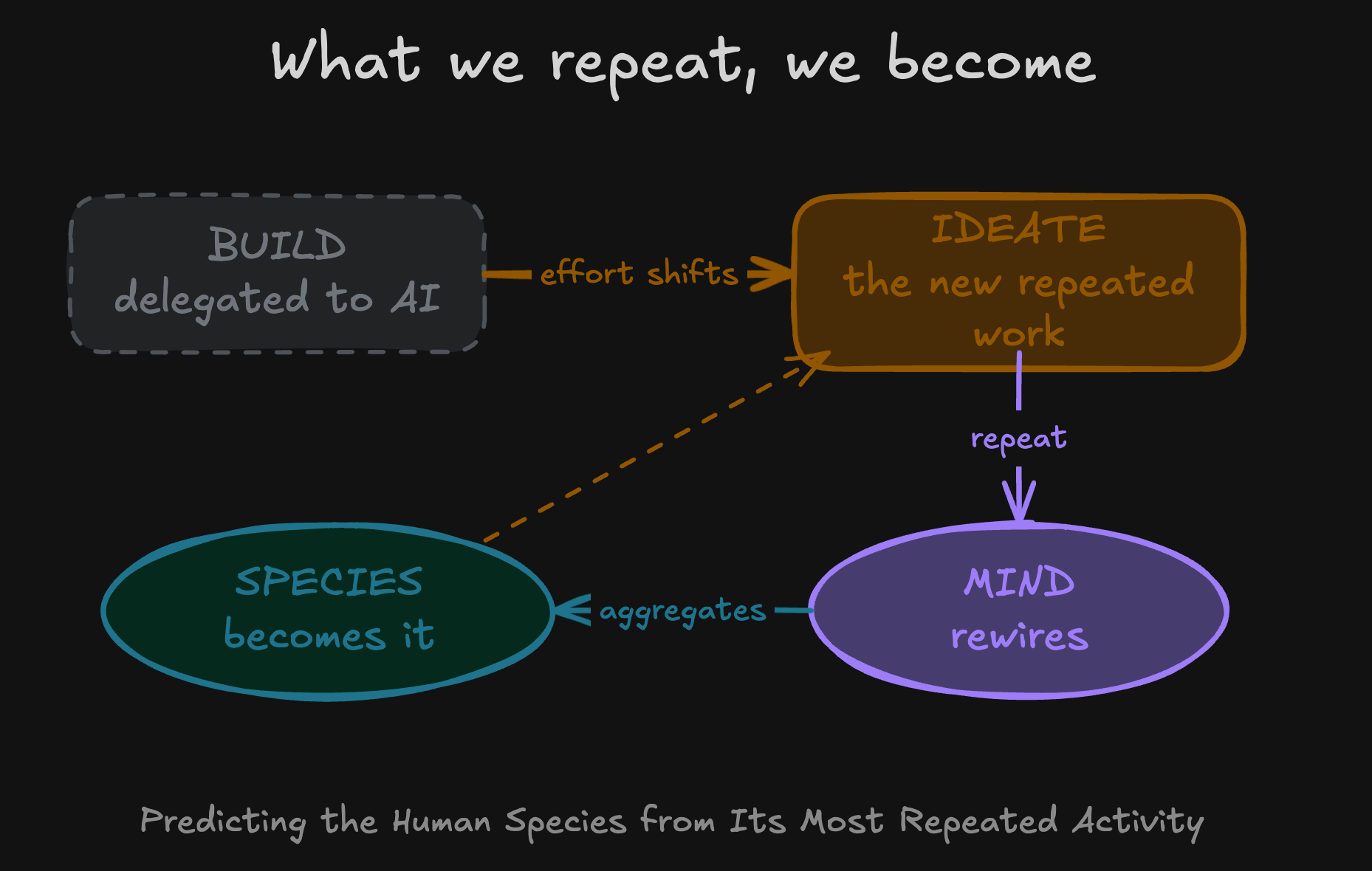
Predicting the Human Species from Its Most Repeated Activity
What humans repeat shapes how they think and who they become. This essay uses that mechanism to predict the deltas: new awareness of creativity, shallower expertise, broken verification pipelines, and a society that can produce far more than it can evaluate.
AI changed things, and now execution or build time is extremely cheap, particularly for hard skills like software engineering. Therefore, most new effort is no longer spent on execution or building; it's spent on ideating and creating instructions, definitions or structural principles for the delegation of previously human-owned activities. This changes the mind and the brain structure of those who were doing it, whose attention and emotional investment are now spent differently.1
First, it’s important to say that as markets move fast in adoption, it’s not that humans will just relax and delegate, this happens now, but has a limit, and the limit is dictated by how fast society catches up to the point where it is no longer an advantage, or where it can no longer be arbitraged. It’s more like this: now that you can instruct, define and delegate, spend as much time as you used to spend building, but now on the first group of things.
So, What is the outcome for the mind of the aggregated process of spending more time ideating than building, at an individual level and at the aggregate species level?
Doing something persistently and repeatedly creates awareness in individuals of things that they would love to be doing more, things to avoid, and things to change about it, and mostly about themselves (further exposing a model's inference, sometimes overfitted to its priors, to a different activity).2 So we can use this mechanism to predict what those deltas are and where they converge.
I firmly think that a society’s identity comfort and discomfort are a byproduct of what its major workforce repeats the most, because that’s what they can identify with best.
Some of the deltas this exercise identifies are:
- People will become more aware of their creativity, or their lack of creativity.
- Ideation and construction of principles and governance will displace execution, and the latter will become a a low-status, low-competition activity.
- People will forget or deprioritize knowing how things work in depth.
- Discussions will just scratch surfaces, which would probably make life simpler for the vast majority but a nightmare for complex minds.