Affective Attention Capture: The Instrumentalization of Media Channels for Belief Formation and Behavioral Control · vicente.md
vicente.md/2026-003 [q-bio.NC] · 8 Oct 2026
Preprint · not peer reviewed 18 pages
Affective Attention Capture: The Instrumentalization of Media Channels for Belief Formation and Behavioral Control
Vicente González B.†
Engineer and Computational Neuroscience Researcher · Santiago, Chile
† correspondence · hi@vicente.md · no institutional funding, no competing interests
Abstract
A claim can travel through a million voices and still have one author. This paper develops affective attention capture (AAC): the operator-agnostic, prior-contingent extraction of sustained attention from aggregated populations. An operator, meaning any actor who understands the principle and controls some distribution, infers a population’s affective priors (its fears, resentments, identities and aspirations) and selects stimuli that resonate with them. Capture occurs when a stimulus’s affective salience outruns the recipient’s self-model resolution, the capacity to represent why one feels what one feels, and stress and load lower that threshold in anyone. The captured then carry the stimulus themselves, sincerely and without instruction; repetition and apparent consensus consolidate it into belief the holder experiences as self-generated; and engagement data return to the operator, who learns. We ground each of these five computations in a framework with independent empirical support: precision-weighted prediction and constructed emotion for resonance; model-free control and affect-as-information for capture; arousal-linked transmission, branching-process criticality and reinforcement of outrage for spread; the illusory truth effect and correlation neglect for consolidation; and source monitoring and confabulation for origin corruption. AAC differs from propaganda in its indifference to content, from persuasion in its pre-propositional entry point, and from engagement optimization in its intentional modeling of priors. Its decisive asymmetry is resolution, not intelligence. The contribution is the composition, not the parts: we mark which links are established, which are proposed and which have weakened under replication, state six falsifiable predictions, and argue that because capture is indifferent to content, defenses must be too.
“Let’s give these wretches crumbs so they have something to eat, instead of worrying about their own lives, while we profit from their impulsive and uncontrollable attention.”
The operator’s stance, in caricature. This paper is about why nothing so cynical ever needs to be said aloud for it to work.
The puzzle of the sincere amplifier
A claim can travel through a million voices and still have one author. The people who carry it are not following instructions. They are angry, frightened, hopeful or certain, and they act on their own initiative: they post, condemn, warn the people they love, demand that someone be fired. Each of them is sincere. Together they do something useful for whoever designed the claim, and almost none of them knows that anyone did.
The question, then, is not why people obey a manipulator, because in the cases that matter they don’t. It is how ordinary perception, ordinary feeling and voluntary participation can be composed into an outcome that serves someone upstream.
The intuition is old. Juvenal’s Rome traded its political attention for bread and circuses.1 Three things are new. An operator can now model a population’s affective priors from the traces it leaves, at a resolution no member has over themselves. The channel distributes at near-zero marginal cost, and the population performs most of the distribution itself. And the feedback is immediate: every reaction is a data point, so the operator learns what works and does more of it.
We call the resulting process affective attention capture (AAC). The claim of this paper is narrow and, we think, strong. Each link in the process corresponds to a computation that neuroscience and psychology have characterized independently, often with formal models and replicated measurements. What is proposed here is the composition: that these computations chain, that the chain can be driven from upstream, and that its conserved output is not belief but attention.
per negative word
per out-group term
per SD of anger
top 15% of sharers
+2.3%
+67%
+34%
30–40%
headline click-through, randomized
odds that a post is shared
odds of the most-e-mailed list
of all the false news shared
Four numbers from four different joints of the loop: 105,000 randomized headline variants,2 2.7 million posts by news outlets and legislators,3 6,956 New York Times articles,4 and habitual sharing of false news.5 None measures the whole loop.
The construct
Definition
Definition. Affective attention capture is the operator-agnostic, prior-contingent extraction of sustained attention from aggregated populations. It is triggered when affectively resonant stimuli exceed the target’s self-model resolution, and followed by self-propagated transmission and consolidation into origin-corrupted belief.
Each term carries weight.
Operator-agnostic. The operator is a role, not a class. Anyone who understands the principle, intends to use it and controls a message or its first distribution qualifies: a politician, a newsroom, a brand, a lobby, an influencer, a single account that has learned what its audience cannot resist. Wealth helps. It is not required.
Prior-contingent. The operator does not create the fears it uses. It finds them. The stimulus works because it fits something the audience already expected.
Sustained attention. This is the conserved output. Beliefs, emotions and identities are intermediates; attention is what gets converted into revenue, votes or influence.
Self-model resolution. The precision with which a person can represent the causes of their own current state: the difference between “this is outrageous” and “I am being made to feel outraged.” Capture happens when the stimulus outruns it.
Self-propagated transmission. The captured carry the stimulus onward themselves, and experience doing so as their own choice.
Origin-corrupted belief. A belief whose content survives while the history of how it was produced does not. The holder attributes it to independent reasoning.
What it is not
AAC borrows machinery from propaganda, persuasion and engagement optimization, and in practice the categories overlap. Three features separate it in principle (Table 1). Propaganda is committed to a content: it advances a doctrine and fails if the doctrine is rejected. AAC is indifferent to content: any belief that keeps attention sealed will do, including contradictory beliefs cultivated in different audiences at the same time. Persuasion enters through propositions, through arguments and cues a listener weighs. AAC enters before a proposition is formed, through affect, and the proposition arrives later, if at all. Engagement optimization, the ranking logic of most platforms, exploits whatever engages without modeling why. AAC involves intent: an operator who models the audience’s priors and selects stimuli to exploit them.
Entry point
Commitment to content
Priors
Who distributes
Affective attention capture
Affect, before any claim is weighed
None: any belief that holds attention
Modeled and deliberately exploited
The captured, sincerely
Propaganda
Doctrine, symbols, repetition
High: a specific worldview
Exploited in service of the doctrine
Institutions and loyalists
Persuasion
Arguments and cues
High: a specific attitude change
Incidental
The persuader
Engagement optimization
Whatever engages
None
Discovered, never modeled
The ranking system
Organic rumor or outrage
Affect
None
No operator
Participants
Table 1. Where affective attention capture sits among neighboring constructs, by the features that separate them in principle.
Two exclusions matter. A rumor with no initiator can spread by the same mechanism; it is affective amplification without capture, because nobody upstream benefits by design. And anger at real, verified wrongdoing is not capture even when it travels the same way. A true claim does not become false because it spreads well. The framework describes how attention is taken. It does not license dismissing anyone’s anger as manipulated.
The asymmetry is resolution, not intelligence
It is tempting to call the downstream population gullible. That description is wrong, and it hides the mechanism. The decisive asymmetry is architectural. The operator sees the population in aggregate: which framings were shared, by whom, how fast, with what words in the replies. From records as sparse as Facebook Likes, simple models predict political views, personality and other sensitive attributes of people they have never met.6 Field experiments that matched advertising to personality traits inferred this way reported up to 40% more clicks and 50% more purchases than mismatched ads,7 although critics argued that the design could not separate targeting from the platform’s own ad delivery, so the size of the effect is uncertain.8
No individual has comparable access to their own priors. A person experiences their expectations as the way the world is, not as parameters someone could estimate. The gap between the operator’s model of the audience and the audience’s model of itself is what an earlier note called the arbitrage of inference resolution: a higher-resolution model detects the near neighbors of a concept that a lower-resolution one cannot separate from it, and uses them.
Key insight. The population is not outthought. It is outresolved: the operator observes its affective priors in aggregate, at a resolution no member has over their own.
One loop, five computations
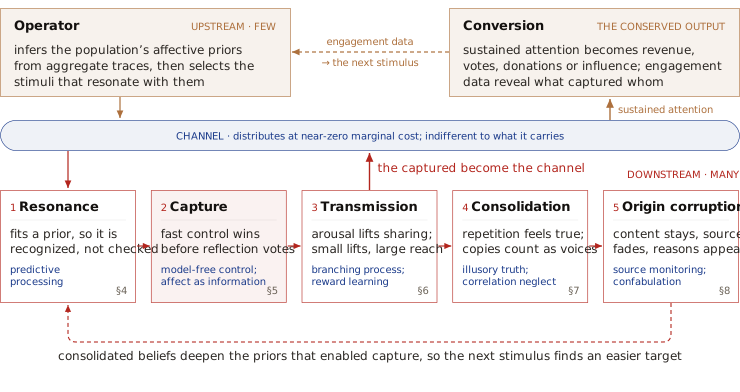
Figure 1 lays out the loop. Upstream, an operator infers priors and selects stimuli, and a channel distributes them. Downstream, five computations follow, each the subject of a section below: resonance, where a stimulus meets a prior; capture, where affect wins control of behavior before reflection does; transmission, where the captured become the channel; consolidation, where repetition and apparent consensus harden into belief; and origin corruption, where the belief loses its history and acquires reasons. Attention flows back to the operator, and so do the data that improve the next stimulus.
Figure 1. The capture loop. Upstream, an operator infers a population’s affective priors and selects stimuli that resonate with them; a channel distributes them. Downstream, five computations follow, each labeled with the framework that characterizes it and the section that discusses it. Transmission feeds back into the channel, because the captured become distributors. Sustained attention flows to conversion, and engagement data return to the operator as better targeting, while consolidated beliefs deepen the priors that enabled capture. Each arrow is a link with independent empirical support; the complete loop is this paper’s hypothesis. Conceptual schematic.
To keep the argument concrete, one fictional episode runs through every stage.
Example. After a storm, water service is restored unevenly across a city. A monetized local page posts a forty-second clip in which a utility executive appears to say that a low-income district “can wait.” The clip is cut from a two-minute answer in which the executive explained that crews were being sequenced by hospital load. The page is paid by the view.
Resonance: priors that recognize instead of evaluate
Example, continued. For residents who already expect institutions to protect the comfortable and neglect everyone else, the clip does not register as a claim to be checked. It registers as confirmation. Of course they said that.
Affective priors as high-precision predictions
Predictive-processing accounts treat the brain as an inference engine that continuously predicts its inputs and updates on the difference, the prediction error.9 The crucial quantity is precision, the confidence a prediction or an error carries.10 Attention, in this framework, is the allocation of precision: deciding which errors are allowed to update the model and which are ignored.11 Emotion fits the same scheme. On constructive and interoceptive accounts, a feeling is the brain’s best prediction of what a bodily change means for what matters to the organism, categorized with the concepts it has learned.1213
Read this way, an affective prior is a high-precision expectation about a valued outcome (threat, injustice, belonging, control) that arrives bundled with its bodily forecast. A stimulus that fits it is categorized rather than examined, and categorization brings the prior’s confidence and its feeling along with it. The fit feels like evidence. This is the central substitution of resonance: a plausible general pattern (“they always protect their own”) stands in for verification of a specific event (“did this executive say this?”). The most effective stimuli are surprising at the level of the event and unsurprising at the level of its meaning. The novelty earns the glance; the fit earns the belief.
The empirical record supports each part of this. The amygdala sends direct and indirect signals that enhance the sensory processing of emotionally significant events, especially threats, in a form of emotional attention that competes with goal-directed control.14 Stimuli that were merely paired with reward go on capturing attention involuntarily, against the observer’s goals and long after the reward has stopped, and susceptibility varies with working-memory capacity and impulsivity.15 Most directly, moral and emotional words are prioritized in early visual attention relative to neutral words, and in nearly 50,000 political tweets the content that captured attention in the laboratory was also the content retweeted more; the advantage was not fully explained by arousal.16 Affect can also precede the proposition: evaluative reactions can be faster and more confident than the cognitive judgments they are supposed to follow.17 This is the pre-propositional entry point of Table 1.
Eight families of priors
Which priors matter? A provisional inventory drafted for this framework listed twenty; they condense into the eight families of Table 2. Meta-analytic evidence links conspiracy belief to epistemic, existential and social motives (r ≈ .14–.16 across 279 studies),18 which supports measuring uncertainty, control and identity as separate ingredients but does not validate any particular taxonomy.
Family
The prior predicts
Stimuli that resonate
Action it licenses
Control
Outcomes are decided by people we cannot reach
Revelations of hidden coordination
Withdrawal, unless a reachable enemy is supplied
Impunity and betrayal
Protectors defect; the powerful escape consequences
Cover-ups, insider protection, double standards
Exposure; demands for sanction
Deprivation and status
Their gain is our loss; people like us are disregarded
Unfair-advantage and humiliation stories
Resentment; out-group derogation
Threat and hostile intent
Harm is coming, and someone means it
Attacks, invasions, contamination
Vigilance; defensive mobilization
Moral duty
Silence is complicity; punishment restores order
A victim paired with a villain
Condemnation, boycott, removal
Belonging
Dissent costs membership
Loyalty tests, “whose side are you on”
Conformity in public expression
Aspiration
A shortcut to status or safety exists
Windfalls, transformations, chosen-few narratives
Buying, joining, evangelizing
Decline and rescue
Things will get worse; only a strong protector can stop it
Collapse narratives with a savior
Deference to concentrated authority
Table 2. Eight families of affective priors, condensed from a longer provisional inventory. They are candidates for measurement, not diagnoses, and nothing here assigns them to any income, education or national category. The right-hand column carries the argument: priors differ less in what they make people feel than in what they make people do.
From resignation to a target
“Nothing we do changes anything” predicts withdrawal, not amplification. An operator who needs mobilization has to convert resignation into action, and the conversion has a known psychology. When people’s sense of control is threatened, they attribute more influence to their enemies, and perceiving a powerful enemy under threat restores a sense of personal control and lowers perceived risk.19 More broadly, reduced control increases the appeal of simple, structured explanations, with a moderate meta-analytic effect (r = .25),20 though some individual effects in this literature have not replicated.21 An enemy is a structure. The system may be immovable, but this executive can be fired. The operator’s move is to supply a reachable target for an unreachable grievance, converting low efficacy over the system into high efficacy over a sanction. Prediction P2 in Table 4 tests exactly this bridge.
Capture: when salience outruns self-model resolution
Example, continued. It is nine in the evening. Many of the people seeing the clip have spent the day without running water. The anger arrives before the question of whether this is the whole answer. By the time anyone might ask it, they have already replied.
Two controllers and an arbiter
Decision neuroscience distinguishes two ways of choosing. A model-free controller acts on cached values, on what has worked before, fast and cheap. A model-based controller simulates consequences with an internal model of the world, slow and flexible. The brain arbitrates between them according to their relative reliability, and behavior follows whichever wins.22 In these terms, capture is the model-free system winning the arbitration for attention and action before the model-based system has evaluated the input. The reply, the share and the furious comment are emitted on cached affective value.
Self-model resolution, made operational
The note that introduced AAC located capture at the point where stimulus salience exceeds the target’s self-model resolution. That phrase needs an operational meaning, and research on affect as information supplies one. People use their current feelings as information about whatever they are judging, unless the feeling’s real source becomes salient. In a classic study, people telephoned on sunny days reported higher satisfaction with their lives than people telephoned on rainy days; when the interviewer first asked about the weather, the effect on life satisfaction disappeared while the effect on mood remained.23 The feeling did not go away. Its authority did. Once attributed to its cause, it stopped counting as evidence about a life.
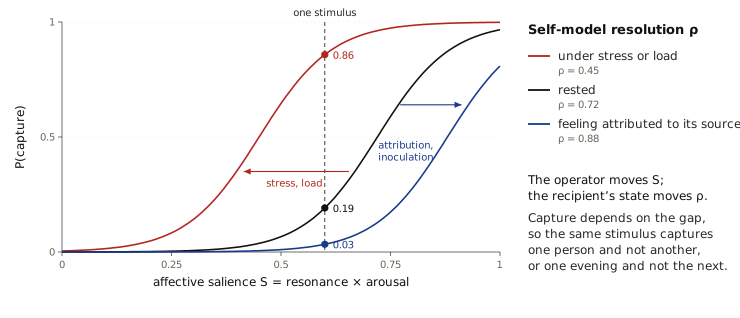
Self-model resolution is that capacity taken as a variable: the precision with which a person can represent why they feel what they feel, at the moment it matters. Low resolution yields “this is outrageous.” High resolution yields “this was built to outrage me, and I should check whether it is true.” The first projects the feeling onto the world; the second keeps it as a fact about the self. A minimal formalization makes the threshold explicit:
P(capture)=σ(β[S−ρ]),S=resonance×arousal
Here S is the stimulus’s affective salience, which the operator controls by choosing what to show and to whom; ρ is the recipient’s self-model resolution at that moment; β sets how sharp the threshold is; and σ is the logistic function, which turns the gap into a probability. The equation is a schematic, not a fitted model. Its content is that capture depends on a difference, so the same stimulus captures one person and not another, and the same person on one evening and not the next (Figure 2).
Figure 2. Capture as a threshold, equation (1). The probability of capture rises as a stimulus’s affective salience exceeds the recipient’s self-model resolution. Stress and cognitive load shift the curve to the left, so a single stimulus (dashed line) captures a recipient under load with high probability and a rested recipient with low probability; attributing the feeling to its source, or learning to recognize the technique, shifts the curve to the right. The directions follow the evidence cited in the text; the curve shapes and magnitudes are illustrative, not fitted.
What lowers the threshold
What moves ρ most reliably is not intelligence but state. Acute stress weakens model-based contributions to choice while leaving model-free ones intact, and people with lower working-memory capacity are more affected.24 Stress before learning shifts behavior toward habits that no longer track whether the outcome is still wanted.25 Even mild uncontrollable stress can rapidly impair prefrontal function.26 At the moment of sharing, attention itself is the scarce resource. People’s sharing intentions barely track whether a headline is true even though their accuracy judgments do,27 and susceptibility to false headlines is predicted better by a lack of reflection than by partisan motivation.28
This is how the claim that the disadvantaged are especially exposed should be read. Financial worry has been reported to impair cognitive performance,29 but the scarcity literature replicates unevenly and the evidence for a general tax on mental bandwidth is inconclusive.3031 What is well supported is that stress and load lower the threshold in anyone. Precarity matters because it supplies stress and load more often, not because it marks a kind of person. The threshold is set by situations, and some lives contain more of them.
Transmission: the captured become the channel
Example, continued. “People need to know.” The clip is reposted with captions demanding the executive’s dismissal. In neighborhood groups, where most members share the same expectation, nearly every viewer passes it on. Outside them, most people scroll past.
Arousal, not valence
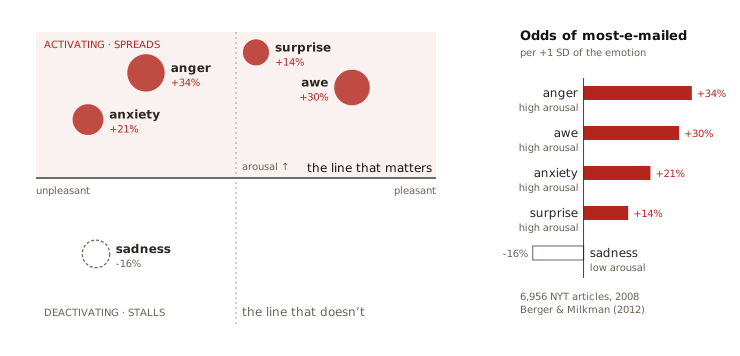
Emotions vary along two broad dimensions, how pleasant they feel and how activating they are,32 and the ones that spread are defined by the second. Across 6,956 New York Times articles, content that evoked activating emotions was more likely to reach the most-e-mailed list whether the emotion was unpleasant (anger +34% per standard deviation, anxiety +21%) or pleasant (awe +30%), while deactivating sadness made it less likely (−16%).4 Placement mattered too, yet one standard deviation of anger was worth as much as nearly three extra hours as the site’s lead story. One caution is needed: a laboratory study reporting that incidental physiological arousal alone increases sharing33 failed to replicate in two larger samples,34 so the field pattern is better read as a property of activating emotions in context than as a simple effect of arousal (Figure 3).
Figure 3. Arousal, not valence, separates emotions that spread from emotions that stall. Emotions are placed on the valence and arousal axes of the affective circumplex; positions are schematic, after Russell (1980). Bubble area and the bars on the right show the change in the odds of reaching the New York Times most-e-mailed list per standard-deviation increase in each emotion, from 6,956 articles published in 2008 (Berger and Milkman, 2012). Activating emotions spread whether pleasant or unpleasant; deactivating sadness stalls. Observational data; the related causal claim about incidental arousal did not replicate.
This is the empirical form of the original note’s insistence that the specific reaction does not matter. Anger, fear, euphoria and awe all transmit. Despair does not, which is why resignation has to be converted (Section 4.3) before it can be used.
The pattern holds on social platforms. Each term referring to the political out-group raised the odds that a post was shared by 67%, the strongest predictor measured and several times stronger than negative or moral-emotional language.3 In randomized tests of 105,000 headline variants, each additional negative word raised click-through by 2.3%.2 An analysis of moral-emotional language reported about 20% more diffusion per word, concentrated within ideological networks,35 though a reanalysis found that the moral-contagion model predicted spread no better than an arbitrary control model, a reminder of how easily large observational datasets mislead.36 False news spread farther and faster than true news, and provoked fear, disgust and surprise in its replies.37
Near the critical point
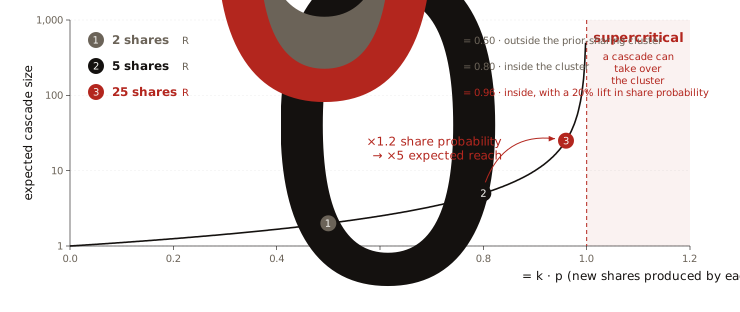
Why do small differences in emotional pull produce enormous differences in reach? Cascades behave like branching processes. If each share exposes k people and each exposed person shares with probability p, every share produces on average R0=kp new shares, and
E[cascade size]=1−R01(R0<1).
Below one, cascades die out, but their expected size grows without bound as R0 approaches one; above one, a cascade can take over the whole cluster. Near the threshold, a modest lift in share probability multiplies reach (Figure 4). A reanalysis of the true-versus-false news data reached the same conclusion from the other side: once cascades were matched on size, the structural differences largely disappeared, consistent with similar spreading mechanisms that differ mainly in basic infectiousness.38 Infectiousness is R0, and R0 is what affective selection buys.
Figure 4. Small affective lifts near the critical point produce large differences in reach. The curve is the expected size of a branching-process cascade, 1/(1 − R0), where R0 is the average number of new shares each share produces; above R0 = 1 the expectation is unbounded. Numbered points show an illustrative audience outside the cluster that shares the relevant prior (R0 = 0.5), the same stimulus inside it (0.8), and inside it with a 20% lift in share probability (0.96): reach grows fivefold. Analytic result; the audience values are illustrative.
Two consequences follow. The operator’s real task is not to persuade but to tune: to find, for each audience, the framing that lifts R0 toward one inside a cluster that shares the relevant prior. And because people inside such a cluster mostly see each other, local prevalence is mistaken for global prevalence. In many network structures, a view held by a minority overall appears as a majority in most people’s neighborhoods.39
Reward, habit and the feeling of autonomy
Once sharing begins, the platform teaches it. Across two preregistered observational studies covering 12.7 million tweets and two experiments, positive social feedback for expressions of outrage increased the probability of future outrage, as reinforcement learning predicts, and users also converged on their networks’ expressive norms.40 An unexpected burst of likes is a positive reward prediction error, the signal dopamine neurons broadcast when an outcome is better than expected.41 Repeated, the behavior becomes a habit cued by the platform itself. In one set of studies the 15% most habitual sharers accounted for 30–40% of the false news shared, and habitual sharers passed on information that contradicted their own politics.5 Digital media lower the costs and raise the rewards of expressing outrage.42
None of this feels like being used. The sharer experiences warning, informing, protecting. That sincerity is what makes the channel effective: a friend’s indignant repost is the most credible conduit a claim can find, and it costs the operator nothing.
Consolidation: a repetitive voice becomes a chorus
Example, continued. By morning the clip has been posted by forty accounts, each cut from the same file, each with its own caption. “Everyone is saying it.”
Two well-replicated mechanisms convert exposure into conviction. The first is repetition. Repeated statements are judged truer than new ones,43 even when people know the correct answer,44 and a single prior exposure raises the perceived accuracy of fabricated headlines a week later, even when they are labeled as disputed and even when they contradict the reader’s politics; only outright implausibility protects.45 On one account, a repeated statement finds more coherent references in memory, which is what truth feels like from the inside.46
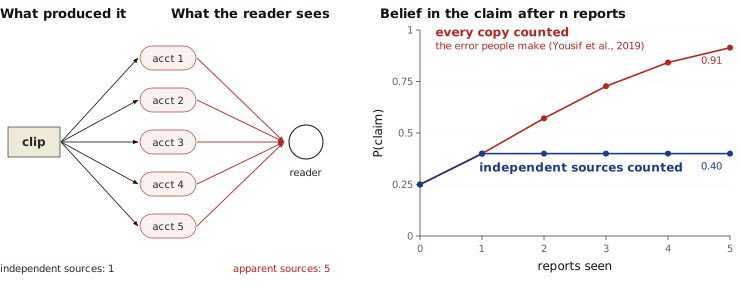
The second mechanism matters more for AAC: people do not track whether the voices they hear are independent. Opinions repeated by a single group member are judged more widespread, even when listeners know there is only one speaker. A repetitive voice can sound like a chorus.47 People are as confident in a conclusion supported by several sources resting on one primary source as in one supported by independent primary sources, even immediately after saying that the second kind is more believable.48 In incentivized experiments, many people treat correlated information as though it were independent.49
The cost of that error is easy to state. For an observer weighing a hypothesis H against reports that each carry a likelihood ratio Λ,
where neff is the number of independent sources. Forty posts cut from one clip contribute neff=1. Counted as forty, the same evidence is added forty times (Figure 5).
Figure 5. One clip, five accounts: a repetitive voice counted as a chorus, equation (3). Left: five accounts repost the same clip, so a reader sees five apparent sources resting on one independent source. Right: the probability assigned to the claim as reports accumulate, for an observer who counts independent sources (one report’s worth of evidence, however many copies arrive) and for one who counts every copy, with a prior probability of 0.25 and a likelihood ratio of 2 per independent report. After five copies the two observers hold 0.40 and 0.91. In experiments, people are as confident in a consensus that rests on one source as in one built from independent sources, which is the upper curve’s error (Yousif et al., 2019). Analytic illustration.
Beliefs that consolidate this way rarely stay neutral facts. When they align with a group, they become part of what membership means, and identity then shapes memory, evaluation and even perception of new information.50 The belief stops being something one has and becomes something one is, which is why it gets defended.
Origin corruption: a belief that feels like one’s own
Example, continued. A week later the full interview circulates and the page quietly deletes the clip. Many residents no longer remember the clip at all. What they remember is that the utility does not care about people like them. They are sure of it, and they will tell you why.
Memory keeps content more durably than it keeps where the content came from. On the source-monitoring framework, memories carry no reliable source labels: the source is inferred at retrieval from the memory’s characteristics, and the inference fails in predictable ways.51 The persuasive impact of a message from a discredited source can grow over time as the discounting cue comes apart from the message, the sleeper effect.52 Corrections rarely erase misinformation completely; it goes on shaping reasoning after it has been retracted.5354
What fills the space left by a forgotten source is a reason. People have limited introspective access to the causes of their judgments and report plausible causal theories instead.55 In choice-blindness experiments, participants who were covertly handed the face they had rejected went on to explain, with reasons, why they had chosen it.56 The belief arrives stripped of its origin and is then furnished with reasons that feel autonomous. That is what origin corruption means: the content survives, the history is replaced, and the holder honestly experiences the result as independent thought.
The loop then closes on itself. Each consolidated belief deepens the priors that made capture possible, so the population is easier to capture with the next stimulus. A prior, as another note put it, should persist in the posterior as evidence, not destiny. Origin corruption turns it back into destiny.
Conversion: two learners, one loop
Example, continued. The page gained tens of thousands of followers that week. The next week it posts another clip, cut to the same template, because the template worked.
Attention is the conserved quantity
“A wealth of information creates a poverty of attention.”57 In an information-rich environment attention is the bottleneck, and the bottleneck selects: for content that is belief-consistent, negative, social and predictive.58 Whatever crosses it can be converted into revenue, votes, donations, status or influence. Beliefs are the means; attention is the product. This is why the specific belief matters less than the captured attention. An operator paid in attention is indifferent to which belief delivers it.
Content indifference as an emergent property
Content indifference does not require cynicism. It falls out of optimization. Publishers test headline variants against each other and keep the winners; in one large archive of such randomized tests, negative words won.2 Audited against a chronological feed, an engagement-based ranking algorithm amplified emotionally charged, out-group hostile content that users themselves said made them feel worse, and that they did not prefer.59 Platforms that profit from engagement have reason to up-regulate emotion.60
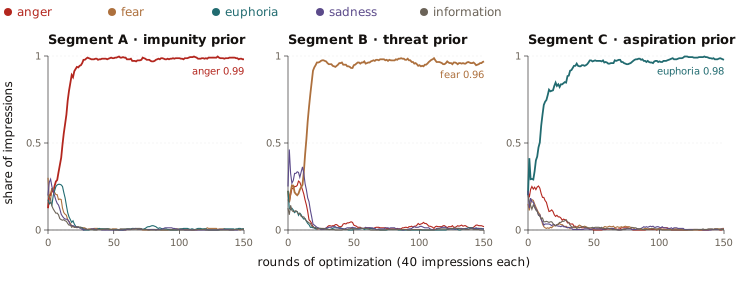
Figure 6 makes the logic visible with a toy model. An optimizer is rewarded only for engagement. It faces three audience segments that differ in their dominant prior and chooses among five kinds of stimulus. It knows nothing about emotion, politics or truth. It converges on anger for one segment, fear for another and euphoria for the third, and abandons sadness and plain information everywhere. Nobody chose to cultivate three emotional populations. The objective did. This is the computational meaning of the observation, in the original note, that different emotional populations can be cultivated at the same time and that the system profits from all of them.
Figure 6. An engagement optimizer cultivates a different emotion in each audience. A Thompson-sampling optimizer, rewarded only for engagement, allocates impressions among five stimulus types in three audience segments that differ in their dominant prior; lines show each stimulus type’s share of impressions over 150 rounds of 40 impressions. Without any representation of emotion or content, it converges on anger for the impunity-prior segment, fear for the threat-prior segment and euphoria for the aspiration-prior segment, and abandons sadness and plain information everywhere. Toy simulation with arbitrary parameters, specified in Appendix A; it illustrates the logic, not real magnitudes.
The loop therefore contains two learners coupled through a single signal. Upstream, the operator learns which stimuli capture which audiences. Downstream, recipients learn through social reward to express what gets rewarded. Engagement reinforces both. An engagement-optimizing platform is the limiting case of an operator with no intent, since it discovers the same stimuli through the same signal. The technology is a conductor. What decides the outcome is who models the priors and what objective the optimization serves.
What is established, and what is proposed
Table 3 separates the parts of the account that rest on replicated evidence from the parts that are this paper’s hypotheses. Every link has independent support. No study has followed one episode through all five, and the end-to-end claim (that an operator’s selection of a stimulus produces sincere transmission, consolidated belief and returned attention) remains a proposal.
Link
Computation and framework
Representative evidence
Status
Resonance
A congruent input is recognized, not checked; predictive processing, constructed emotion
Emotional attention (Vuilleumier); value-driven capture (Anderson); moral words captured early attention (Brady et al., 2020)
Components established; the prior × stimulus interaction is proposed
Capture
The fast controller wins arbitration; affect read as information
Stress weakens model-based control (Otto et al.; Schwabe & Wolf); attribution removes mood effects (Schwarz & Clore)
Components established; self-model resolution as one measurable threshold is proposed
Transmission
Activating emotion raises share probability; reach explodes near the critical point; outrage is reinforced
Activating emotions spread (Berger & Milkman); out-group terms (Rathje et al.); outrage reinforced by likes (Brady et al., 2021); habits (Ceylan et al.)
Supported; incidental arousal and moral contagion weakened under replication
Consolidation
Repetition read as truth; copies counted as independent voices
Illusory truth (Hasher et al.; Fazio et al.; Pennycook et al.); a repetitive voice (Weaver et al.); illusion of consensus (Yousif et al.); correlation neglect (Enke & Zimmermann)
Established in the laboratory; field magnitude open
Origin corruption
Content survives, source decays, reasons are confabulated
Source monitoring (Johnson et al.); sleeper effect (Kumkale & Albarracín); continued influence (Lewandowsky et al.); choice blindness (Johansson et al.)
Components established; the chain is proposed
Conversion
An optimizer selects stimuli by engagement
Negativity wins randomized headline tests (Robertson et al.); engagement ranking amplifies hostility (Milli et al.); psychological targeting (Matz et al., disputed)
Supported; the intent-driven loop is proposed
Table 3. The evidence ledger. Each row names the computation a link performs, the work that establishes it, and what this paper adds. “Proposed” marks claims no cited study tests directly.
Predictions, and how the account fails
The framework earns its keep only if it predicts something its components do not predict separately. Table 4 lists six predictions with the results that would count against them. Two are central. P2 holds that supplying a reachable target is what converts resignation into mobilization; if low-control recipients simply withdraw whatever they are offered, the bridge from despair to outrage fails. P3 holds that apparent source diversity raises perceived consensus beyond what repetition alone does; if disclosing a shared origin changes nothing beyond familiarity, the consolidation branch reduces to the illusory truth effect.
Prediction
Contrast that tests it
Result that would count against it
P1
Prior-congruent stimuli elicit more affect than matched incongruent ones
Priors measured in an earlier session × randomized framing
A prior × framing interaction near zero across powered replications
P2
A reachable target converts low control into mobilization
Low-control recipients randomized to a diffuse or a specific villain
Low-control recipients withdraw regardless of the target
Five independent-looking reports against five visible copies, exposures matched
Disclosing the shared origin changes nothing beyond familiarity
P4
Affect predicts sharing beyond belief in accuracy
Accuracy, affect and sharing elicited separately
The affect effect vanishes once belief is measured reliably
P5
Social reward sustains public expression without changing private belief
Randomized feedback, with public and private measures
Private belief moves with public expression, or neither moves
P6
Operators adapt stimulus selection to engagement
Operator output before and after exogenous engagement shocks
No adaptation, or losses that leave selection unchanged
Table 4. Six predictions and the results that would narrow or reject the framework. A null result should shrink the account, not be redescribed as a subtler form of capture.
Testing these predictions ethically means synthetic claims about fictional organizations in contained environments, priors measured in a session before exposure, affect, accuracy, consensus, sharing and support for sanctions measured as distinct outcomes, and full debriefing. Observational work on real cascades has to reconstruct exposure, not just sharing; the earliest observed post is not proof of origination; and intent requires documentary evidence, never inference from who benefited.
The account must also refuse to become self-sealing. Disagreement is not evidence of capture, and a lack of evidence is not evidence of concealment. Once those moves are allowed, the framework stops explaining and starts insulating.
Defenses must be content-indifferent too
Because capture is indifferent to content, defenses that work claim by claim, checking each clip and removing each falsehood, will always arrive late: the optimizer simply finds the next stimulus. Defenses that act on the mechanism map onto the three quantities of the model.
Raise resolution, ρ. Teaching people to recognize manipulation techniques (emotionally manipulative language, false dichotomies, scapegoating) rather than particular false claims improved discernment and the quality of sharing decisions across seven preregistered studies, including a field study on YouTube.61 Brief prompts that turn attention to accuracy also improve what people share, with modest effects.27 Both act on how a stimulus is processed, not on what it says.
Lower reproduction, R0. Friction before a demand for sanction, and displays that collapse forty derivative posts into one source shown with its original context, act on the two parameters that matter most near the critical point: share probability and the illusion of independence. These are candidate interventions that still need testing for comprehension, unequal burdens and unintended amplification.
Change the reward. Sharing habits are learned from platform rewards, and the same studies that measured them showed that false-news sharing is not an inevitable consequence of habit: restructured rewards can build habits of sharing accurate information.5 In the ranking audit, re-ranking by users’ stated rather than revealed preferences reduced angry, partisan and out-group hostile content, at the cost of some reinforcement of content users already agreed with.59
The right measure of success is discernment, not calm: less endorsement of unsupported allegations, with responsiveness to supported ones preserved. An intervention that simply suppresses angry language would silence justified complaints along with manufactured ones. Outrage at real wrongdoing is a civic resource. The taxonomy in Table 2 is meant for resilience research, never for profiling vulnerable audiences.
Conclusion
The operator in the epigraph says aloud what the system never needs to. No one has to believe that the people downstream are wretches, or decide to feed them crumbs. It is enough to model what they already expect, to select what fits, and to optimize for attention. Perception, feeling, social learning and memory, each working as designed, do the rest. The people who carry the claim are sincere, and their sincerity is the mechanism.
That is why the most durable defense is the oldest one, restated computationally: resolution. A feeling attributed to its cause stops counting as evidence. A chorus recognized as one voice stops being counted forty times. A belief whose origin can be recovered can be kept, revised or dropped on its merits. The point is not to feel less. It is to know where the feeling came from.
The toy optimizer behind Figure 6
Each of three audience segments has a dominant prior, and each of five stimulus types has an arousal level. The probability that one impression is engaged with is 0.01+0.09×resonance×arousal, with the resonance values below. An independent Thompson-sampling optimizer per segment keeps a Beta(1, 1) prior on each stimulus type’s engagement rate, allocates each round’s 40 impressions by sampling from those posteriors, and updates on the engagements it observes, for 150 rounds (random seed 7). It is never told what a stimulus is about.
Segment
Dominant prior
anger
fear
euphoria
sadness
information
A
impunity
1.00
0.45
0.25
0.40
0.50
B
threat
0.50
1.00
0.20
0.40
0.50
C
aspiration
0.25
0.35
1.00
0.30
0.50
arousal
0.90
0.85
0.80
0.25
0.20
Table 5. Resonance of each stimulus type with each segment’s dominant prior, and the arousal of each stimulus type. The values are arbitrary; any parameters in which the best stimulus differs across segments produce the same qualitative result.
import random
defthompson(resonance, arousal, rng, rounds=150, per_round=40):
"""Allocate impressions by Thompson sampling; the only reward is engagement."""
a = {k: 1.0for k in arousal} # Beta(1, 1) prior per stimulus type
b = {k: 1.0for k in arousal}
history = []
for _ inrange(rounds):
shown = {k: 0for k in arousal}
engaged = {k: 0for k in arousal}
for _ inrange(per_round):
pick = max(arousal, key=lambda k: rng.betavariate(a[k], b[k]))
shown[pick] += 1
engaged[pick] += rng.random() < 0.01 + 0.09 * resonance[pick] * arousal[pick]
for k in arousal: # update once per round, on that round's outcomes
a[k] += engaged[k]
b[k] += shown[k] - engaged[k]
history.append({k: shown[k] / per_round for k in arousal})
return history
rng = random.Random(7) # one generator; segments A, B and C run in that order
In the last 20 rounds, the winning stimulus type took 99% of impressions in segment A (anger), 96% in segment B (fear) and 98% in segment C (euphoria).
References
Footnotes
Juvenal. Satires, 10.77–81 (early second century CE). The source of panem et circenses, “bread and circuses.” ↩
Robertson, C. E., Pröllochs, N., Schwarzenegger, K., Pärnamets, P., Van Bavel, J. J., & Feuerriegel, S. (2023). Negativity drives online news consumption. Nature Human Behaviour, 7, 812–822. doi:10.1038/s41562-023-01538-4. ↩↩2↩3
Rathje, S., Van Bavel, J. J., & van der Linden, S. (2021). Out-group animosity drives engagement on social media. Proceedings of the National Academy of Sciences, 118(26), e2024292118. doi:10.1073/pnas.2024292118. Observational. ↩↩2
Berger, J., & Milkman, K. L. (2012). What makes online content viral? Journal of Marketing Research, 49(2), 192–205. doi:10.1509/jmr.10.0353. Field data are observational; effect sizes are from the paper’s Figure 2. ↩↩2
Ceylan, G., Anderson, I. A., & Wood, W. (2023). Sharing of misinformation is habitual, not just lazy or biased. Proceedings of the National Academy of Sciences, 120(4), e2216614120. doi:10.1073/pnas.2216614120. ↩↩2↩3
Kosinski, M., Stillwell, D., & Graepel, T. (2013). Private traits and attributes are predictable from digital records of human behavior. Proceedings of the National Academy of Sciences, 110(15), 5802–5805. doi:10.1073/pnas.1218772110. ↩
Matz, S. C., Kosinski, M., Nave, G., & Stillwell, D. J. (2017). Psychological targeting as an effective approach to digital mass persuasion. Proceedings of the National Academy of Sciences, 114(48), 12714–12719. doi:10.1073/pnas.1710966114. ↩
Eckles, D., Gordon, B. R., & Johnson, G. A. (2018). Field studies of psychologically targeted ads face threats to internal validity. Proceedings of the National Academy of Sciences, 115(23), E5254–E5255. doi:10.1073/pnas.1805363115. ↩
Friston, K. (2010). The free-energy principle: a unified brain theory? Nature Reviews Neuroscience, 11(2), 127–138. doi:10.1038/nrn2787. ↩
Clark, A. (2013). Whatever next? Predictive brains, situated agents, and the future of cognitive science. Behavioral and Brain Sciences, 36(3), 181–204. doi:10.1017/S0140525X12000477. ↩
Feldman, H., & Friston, K. J. (2010). Attention, uncertainty, and free-energy. Frontiers in Human Neuroscience, 4, 215. doi:10.3389/fnhum.2010.00215. ↩
Barrett, L. F. (2017). The theory of constructed emotion: an active inference account of interoception and categorization. Social Cognitive and Affective Neuroscience, 12(1), 1–23. doi:10.1093/scan/nsw154. ↩
Seth, A. K. (2013). Interoceptive inference, emotion, and the embodied self. Trends in Cognitive Sciences, 17(11), 565–573. doi:10.1016/j.tics.2013.09.007. ↩
Vuilleumier, P. (2005). How brains beware: neural mechanisms of emotional attention. Trends in Cognitive Sciences, 9(12), 585–594. doi:10.1016/j.tics.2005.10.011. ↩
Anderson, B. A., Laurent, P. A., & Yantis, S. (2011). Value-driven attentional capture. Proceedings of the National Academy of Sciences, 108(25), 10367–10371. doi:10.1073/pnas.1104047108. ↩
Brady, W. J., Gantman, A. P., & Van Bavel, J. J. (2020). Attentional capture helps explain why moral and emotional content go viral. Journal of Experimental Psychology: General, 149(4), 746–756. doi:10.1037/xge0000673. ↩
Zajonc, R. B. (1980). Feeling and thinking: preferences need no inferences. American Psychologist, 35(2), 151–175. doi:10.1037/0003-066X.35.2.151. ↩
Biddlestone, M., Green, R., Douglas, K. M., Azevedo, F., Sutton, R. M., & Cichocka, A. (2025). Reasons to believe: a systematic review and meta-analytic synthesis of the motives associated with conspiracy beliefs. Psychological Bulletin, 151(1), 48–87. doi:10.1037/bul0000463. Associations were weaker in experimental than in correlational designs. ↩
Sullivan, D., Landau, M. J., & Rothschild, Z. K. (2010). An existential function of enemyship: evidence that people attribute influence to personal and political enemies to compensate for threats to control. Journal of Personality and Social Psychology, 98(3), 434–449. doi:10.1037/a0017457. ↩
Landau, M. J., Kay, A. C., & Whitson, J. A. (2015). Compensatory control and the appeal of a structured world. Psychological Bulletin, 141(3), 694–722. doi:10.1037/a0038703. ↩
van Elk, M., & Lodder, P. (2018). Experimental manipulations of personal control do not increase illusory pattern perception. Collabra: Psychology, 4(1), 19. doi:10.1525/collabra.155. ↩
Daw, N. D., Niv, Y., & Dayan, P. (2005). Uncertainty-based competition between prefrontal and dorsolateral striatal systems for behavioral control. Nature Neuroscience, 8(12), 1704–1711. doi:10.1038/nn1560. ↩
Schwarz, N., & Clore, G. L. (1983). Mood, misattribution, and judgments of well-being: informative and directive functions of affective states. Journal of Personality and Social Psychology, 45(3), 513–523. doi:10.1037/0022-3514.45.3.513. Small samples; the weather effect itself has replicated inconsistently in large panel data. ↩
Otto, A. R., Raio, C. M., Chiang, A., Phelps, E. A., & Daw, N. D. (2013). Working-memory capacity protects model-based learning from stress. Proceedings of the National Academy of Sciences, 110(52), 20941–20946. doi:10.1073/pnas.1312011110. ↩
Schwabe, L., & Wolf, O. T. (2009). Stress prompts habit behavior in humans. Journal of Neuroscience, 29(22), 7191–7198. doi:10.1523/JNEUROSCI.0979-09.2009. ↩
Arnsten, A. F. T. (2009). Stress signalling pathways that impair prefrontal cortex structure and function. Nature Reviews Neuroscience, 10(6), 410–422. doi:10.1038/nrn2648. ↩
Pennycook, G., Epstein, Z., Mosleh, M., Arechar, A. A., Eckles, D., & Rand, D. G. (2021). Shifting attention to accuracy can reduce misinformation online. Nature, 592, 590–595. doi:10.1038/s41586-021-03344-2. ↩↩2
Pennycook, G., & Rand, D. G. (2019). Lazy, not biased: susceptibility to partisan fake news is better explained by lack of reasoning than by motivated reasoning. Cognition, 188, 39–50. doi:10.1016/j.cognition.2018.06.011. ↩
Mani, A., Mullainathan, S., Shafir, E., & Zhao, J. (2013). Poverty impedes cognitive function. Science, 341(6149), 976–980. doi:10.1126/science.1238041. ↩
de Bruijn, E.-J., & Antonides, G. (2022). Poverty and economic decision making: a review of scarcity theory. Theory and Decision, 92, 5–37. doi:10.1007/s11238-021-09802-7. ↩
O’Donnell, M., Dev, A. S., Antonoplis, S., et al. (2021). Empirical audit and review and an assessment of evidentiary value in research on the psychological consequences of scarcity. Proceedings of the National Academy of Sciences, 118(44), e2103313118. doi:10.1073/pnas.2103313118. Replications of 20 scarcity studies, with mixed success. ↩
Russell, J. A. (1980). A circumplex model of affect. Journal of Personality and Social Psychology, 39(6), 1161–1178. doi:10.1037/h0077714. Source of the valence and arousal axes used in Figure 3. ↩
Berger, J. (2011). Arousal increases social transmission of information. Psychological Science, 22(7), 891–893. doi:10.1177/0956797611413294. ↩
Prowten, S., Walker, E., London, B., Pearce, E., Napoli, A., Chenevert, B., Clevenger, C., & Smith, A. R. (2024). Does physiological arousal increase social transmission of information? Two replications of Berger (2011). Psychological Science, 35(9), 1025–1034. doi:10.1177/09567976241257255. ↩
Brady, W. J., Wills, J. A., Jost, J. T., Tucker, J. A., & Van Bavel, J. J. (2017). Emotion shapes the diffusion of moralized content in social networks. Proceedings of the National Academy of Sciences, 114(28), 7313–7318. doi:10.1073/pnas.1618923114. ↩
Burton, J. W., Cruz, N., & Hahn, U. (2021). Reconsidering evidence of moral contagion in online social networks. Nature Human Behaviour, 5(12), 1629–1635. doi:10.1038/s41562-021-01133-5. ↩
Vosoughi, S., Roy, D., & Aral, S. (2018). The spread of true and false news online. Science, 359(6380), 1146–1151. doi:10.1126/science.aap9559. ↩
Juul, J. L., & Ugander, J. (2021). Comparing information diffusion mechanisms by matching on cascade size. Proceedings of the National Academy of Sciences, 118(46), e2100786118. doi:10.1073/pnas.2100786118. ↩
Lerman, K., Yan, X., & Wu, X.-Z. (2016). The “majority illusion” in social networks. PLOS ONE, 11(2), e0147617. doi:10.1371/journal.pone.0147617. ↩
Brady, W. J., McLoughlin, K., Doan, T. N., & Crockett, M. J. (2021). How social learning amplifies moral outrage expression in online social networks. Science Advances, 7(33), eabe5641. doi:10.1126/sciadv.abe5641. ↩
Schultz, W., Dayan, P., & Montague, P. R. (1997). A neural substrate of prediction and reward. Science, 275(5306), 1593–1599. doi:10.1126/science.275.5306.1593. ↩
Crockett, M. J. (2017). Moral outrage in the digital age. Nature Human Behaviour, 1(11), 769–771. doi:10.1038/s41562-017-0213-3. A perspective, not an empirical study. ↩
Hasher, L., Goldstein, D., & Toppino, T. (1977). Frequency and the conference of referential validity. Journal of Verbal Learning and Verbal Behavior, 16(1), 107–112. doi:10.1016/S0022-5371(77)80012-1. ↩
Fazio, L. K., Brashier, N. M., Payne, B. K., & Marsh, E. J. (2015). Knowledge does not protect against illusory truth. Journal of Experimental Psychology: General, 144(5), 993–1002. doi:10.1037/xge0000098. ↩
Pennycook, G., Cannon, T. D., & Rand, D. G. (2018). Prior exposure increases perceived accuracy of fake news. Journal of Experimental Psychology: General, 147(12), 1865–1880. doi:10.1037/xge0000465. ↩
Unkelbach, C., & Rom, S. C. (2017). A referential theory of the repetition-induced truth effect. Cognition, 160, 110–126. doi:10.1016/j.cognition.2016.12.016. ↩
Weaver, K., Garcia, S. M., Schwarz, N., & Miller, D. T. (2007). Inferring the popularity of an opinion from its familiarity: a repetitive voice can sound like a chorus. Journal of Personality and Social Psychology, 92(5), 821–833. doi:10.1037/0022-3514.92.5.821. ↩
Yousif, S. R., Aboody, R., & Keil, F. C. (2019). The illusion of consensus: a failure to distinguish between true and false consensus. Psychological Science, 30(8), 1195–1204. doi:10.1177/0956797619856844. ↩
Enke, B., & Zimmermann, F. (2019). Correlation neglect in belief formation. The Review of Economic Studies, 86(1), 313–332. doi:10.1093/restud/rdx081. ↩
Van Bavel, J. J., & Pereira, A. (2018). The partisan brain: an identity-based model of political belief. Trends in Cognitive Sciences, 22(3), 213–224. doi:10.1016/j.tics.2018.01.004. ↩
Johnson, M. K., Hashtroudi, S., & Lindsay, D. S. (1993). Source monitoring. Psychological Bulletin, 114(1), 3–28. doi:10.1037/0033-2909.114.1.3. ↩
Kumkale, G. T., & Albarracín, D. (2004). The sleeper effect in persuasion: a meta-analytic review. Psychological Bulletin, 130(1), 143–172. doi:10.1037/0033-2909.130.1.143. ↩
Lewandowsky, S., Ecker, U. K. H., Seifert, C. M., Schwarz, N., & Cook, J. (2012). Misinformation and its correction: continued influence and successful debiasing. Psychological Science in the Public Interest, 13(3), 106–131. doi:10.1177/1529100612451018. ↩
Ecker, U. K. H., Lewandowsky, S., Cook, J., Schmid, P., Fazio, L. K., Brashier, N., Kendeou, P., Vraga, E. K., & Amazeen, M. A. (2022). The psychological drivers of misinformation belief and its resistance to correction. Nature Reviews Psychology, 1(1), 13–29. doi:10.1038/s44159-021-00006-y. ↩
Nisbett, R. E., & Wilson, T. D. (1977). Telling more than we can know: verbal reports on mental processes. Psychological Review, 84(3), 231–259. doi:10.1037/0033-295X.84.3.231. ↩
Johansson, P., Hall, L., Sikström, S., & Olsson, A. (2005). Failure to detect mismatches between intention and outcome in a simple decision task. Science, 310(5745), 116–119. doi:10.1126/science.1111709. ↩
Simon, H. A. (1971). Designing organizations for an information-rich world. In M. Greenberger (Ed.), Computers, Communications, and the Public Interest (pp. 37–72). Johns Hopkins Press. ↩
Hills, T. T. (2019). The dark side of information proliferation. Perspectives on Psychological Science, 14(3), 323–330. doi:10.1177/1745691618803647. ↩
Milli, S., Carroll, M., Wang, Y., Pandey, S., Zhao, S., & Dragan, A. D. (2025). Engagement, user satisfaction, and the amplification of divisive content on social media. PNAS Nexus, 4(3), pgaf062. doi:10.1093/pnasnexus/pgaf062. ↩↩2
Goldenberg, A., & Gross, J. J. (2020). Digital emotion contagion. Trends in Cognitive Sciences, 24(4), 316–328. doi:10.1016/j.tics.2020.01.009. ↩
Roozenbeek, J., van der Linden, S., Goldberg, B., Rathje, S., & Lewandowsky, S. (2022). Psychological inoculation improves resilience against misinformation on social media. Science Advances, 8(34), eabo6254. doi:10.1126/sciadv.abo6254. ↩
Cite as: Vicente González B.. “Affective Attention Capture: The Instrumentalization of Media Channels for Belief Formation and Behavioral Control.” vicente.md/2026-003, 8 Oct 2026.← Archive